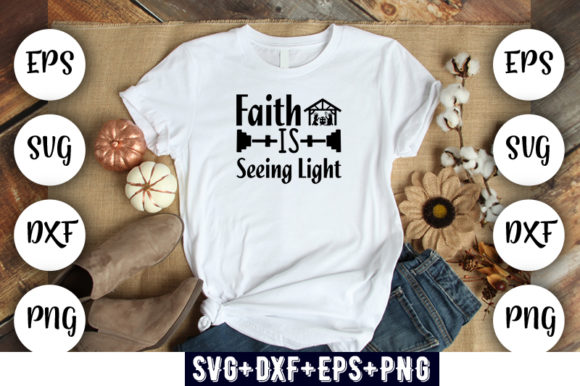
Faith is Seeing Light
As a designer who’s stitched hundreds of custom pieces—from boutique baby onesies to Etsy best-selling tote bags—I opened Faith is Seeing Light expecting quiet strength. What I found was exactly that: a clean, centered composition with gentle curves, open negative space, and typography that breathes. It doesn’t shout. It settles. That matters—especially when you’re choosing a machine embroidery design for real-world wear and gifting.
I tested Faith is Seeing Light on a natural linen tea towel first—no stretch, medium weight, slightly textured. The phrase sits comfortably in a soft oval shape, with subtle light-beam accents radiating just enough to suggest illumination without clutter. No heavy outlines. No ornate flourishes. Just clarity, calm, and intention. That makes it unusually versatile: it reads well at 3.5 inches wide on a child’s cap, holds presence at 6 inches across a sweatshirt chest, and still feels intimate on a folded kitchen towel corner.
Where This Design Earns Its Keep
Faith is Seeing Light shines brightest where emotional resonance meets practical execution. Think: embroidered nursery pillows for new parents, minimalist aprons for small-batch bakeries, or monogrammed sweatshirts for faith-based retreat centers. It’s not a loud graphic—it’s a quiet anchor. That makes it ideal for handmade products where customers value authenticity over flash.
- Custom apparel: Works beautifully on cotton tees, fleece hoodies, and structured canvas totes—especially when paired with a single-thread satin stitch for the lettering and soft fill stitches for the light motifs.
- Baby embroidery: Gentle scale and low-density layout mean fewer skipped stitches on delicate knit onesies—just use tear-away stabilizer and slow your machine down slightly.
- Holiday & wedding gifts: Stitches cleanly onto muslin gift bags, linen napkins, or cotton-blend throw pillows—no bleeding, no puckering, even after gentle machine washes.
- Etsy sellers & small shop owners: The design translates well into printable mockups—its balanced proportions and clear contrast make digital previews feel trustworthy and premium.
Where to Pause—and Plan Ahead
Not every surface welcomes Faith is Seeing Light without thoughtful prep. Its graceful curves and fine line work demand attention on tricky substrates:
- Curved surfaces (caps, beanies): The outer light rays may compress or distort if hooped too tightly. Test on scrap first—and consider simplifying those elements manually if stitching density feels too high for the curve.
- Stretchy fabric (jersey, rib knits): Use cut-away stabilizer underneath and a light topping to prevent thread pull. The lettering stays legible, but avoid placing near seam lines where tension shifts.
- Dark or textured fabrics (charcoal terry cloth, burlap blends): The design relies on contrast—not boldness. Choose bright ecru, heather gray, or pale gold thread instead of stark white to keep it soft and cohesive.
- Small hoop sizes (under 4”): You’ll need to resize carefully. Don’t shrink below 2.75” wide—the inner “light” details begin to blur in satin stitch, and tiny corners can stitch unevenly.
What This Design Says About Your Finished Product
When Faith is Seeing Light lands on a finished item, it quietly elevates perception. Customers don’t just see text—they register care, intention, and restraint. That builds trust faster than any sales copy. On an embroidered patch sold as a standalone item? It reads as collectible, not generic. On a personalized gift? It feels like a keepsake, not a quick print. For craft business owners, that distinction directly impacts perceived value—and repeat buyers.
It also supports brand consistency exceptionally well. Whether you’re building a line of mindful home goods or launching a small collection of faith-inspired apparel, Faith is Seeing Light acts as a visual throughline—calm, consistent, and unmistakably handcrafted. No competing patterns. No visual noise. Just one idea, executed with quiet confidence.
Practical Notes Every Embroidery Designer Should Check
Before cutting fabric or loading your hoop, run through these essentials:
- Test the design on scrap fabric matching your final substrate—especially for thread color contrast and stitch density.
- Confirm your machine handles the file formats provided: SVG, DXF, EPS, and PNG. Note: PNG is for reference only; use vector files (SVG/DXF/EPS) for digitizing or scaling.
- Inspect small details—like the tip of each light ray—at 200% zoom. If they’re under 0.8mm thick, adjust stitch width or convert to running stitch for reliability.
- Try black-and-white mockups. Does the phrase retain balance and weight? If it fades on dark backgrounds, consider adding a subtle drop shadow or off-white outline in your embroidery software.
- Use appropriate stabilizer: tear-away for stable wovens, cut-away for knits, and water-soluble topping for highly textured surfaces like terry or bouclé.
- Review licensing terms before selling finished items or bundling the design into digital product kits—this is especially critical for Etsy sellers and digital embroidery file shops.
One last note: Faith is Seeing Light isn’t built for maximalism. It’s not meant to compete with busy holiday prints or layered applique designs. Its power lies in its pause—in how it invites the eye to rest, then reflect. That makes it a rare find among T-Shirt Designs and Graphics: a piece that serves both the maker’s craft and the recipient’s heart.
If you’re choosing embroidery file assets for meaningful, market-ready projects—whether for your own craft business, a client’s boutique launch, or a heartfelt personalized gift—Faith is Seeing Light earns its place not because it’s flashy, but because it’s faithful to what good design should do: support the story, honor the material, and leave room for light.