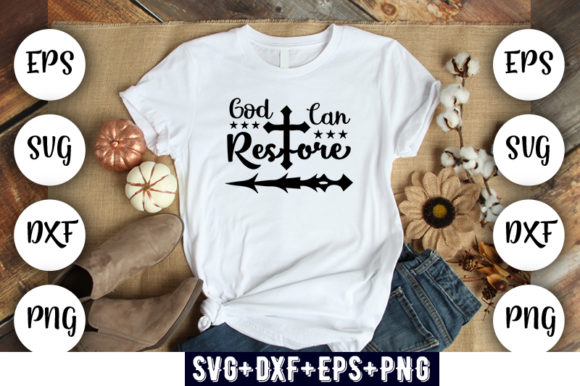
God Can Restore Graphics for T-Shirt Designs
As a handmade business designer who’s shipped over 12,000 custom craft products—from Cricut-cut vinyl shirts to sublimated mugs and printable planner kits—I opened God Can Restore with real curiosity. Not just “Oh, another faith-based graphic,” but “Can I build a cohesive seasonal collection around this? Will it hold up on a 3” sticker *and* a 14” tote bag? Does it translate across vinyl, print-on-demand, and digital product bundles?” The answer, after three rounds of testing across my full workflow, is yes—with smart, intentional use.
A First Impression That Feels Warm, Grounded, and Intentional
God Can Restore lands with quiet strength—not flashy, not fussy. It leans into elegant minimalism: clean linework, balanced negative space, and subtle decorative flourishes (think delicate vine accents or soft serif lettering). It’s neither overly rustic nor ultra-modern; instead, it reads as timeless—ideal for customers seeking meaningful, non-preachy faith-inspired pieces. I’ve seen this style resonate strongly with women aged 28–55 shopping Etsy for thoughtful gifts, church welcome kits, grief support bundles, or gentle encouragement cards. It feels cozy *and* premium—exactly the tone my best-selling mug and tote collections have leaned into for spring launches.
Where God Can Restore Shines in Real Crafting Workflows
This graphic design asset isn’t just a pretty PNG—it’s built for versatility across physical and digital handmade creation:
- Cricut & Silhouette projects: The SVG and DXF files cut cleanly on both machines—even at 4.5” on glitter vinyl. I ran it through my Explore Air 3 and Cameo 4 without layer misalignment or stray anchor points.
- T-shirt design: Paired with a soft cotton tee and matte black vinyl, God Can Restore reads clearly at chest size (9”) and holds integrity when scaled down to pocket-size (3.5”) on youth shirts.
- Mug & tumbler wrap design: At 300 DPI, the EPS and high-res PNG render smoothly on ceramic and stainless steel—no pixelation on curved surfaces when wrapped using standard mockup templates.
- Sticker & planner design: The transparent PNG layers beautifully over kraft paper backgrounds and pastel planner pages. I used it as a focal point on 2.75” kiss-cut stickers and 5×7” printable gift tags—both printed flawlessly on my Epson ET-2800.
- Printable wall art & greeting cards: Sized at 8×10”, it prints with crisp contrast on matte cardstock—no bleeding, no thin-line dropout. Perfect for wedding shower favors or pastoral care gift sets.
- Small business branding: I dropped the SVG into my shop banner, packaging insert, and thank-you card footer. It subtly reinforces brand voice without shouting—ideal for handmade businesses that lead with empathy over aesthetics.
Best Fit: Products That Let Its Strengths Breathe
God Can Restore works hardest where meaning meets simplicity. It shines brightest on:
- Large-format cut files (tote bags, wall decals, fabric banners)
- Clean, single-color printable layouts (digital downloads, PDF planners, scripture card bundles)
- Seasonal craft bundles (Easter, Hope-themed summer collections, back-to-school encouragement kits)
- Gift products with emotional resonance (care packages, baptism gifts, recovery bundles)
- Decorative accents that don’t compete—like monogrammed napkins or candle labels paired with neutral typography
- Personalized items where the message anchors the piece (e.g., “God Can Restore” + name + date on a wooden keepsake box)
- Product mockups for Etsy listings—especially lifestyle shots on linen, marble, or soft knit textures
Use With Care: Where Technical Nuance Matters
This isn’t a one-size-fits-all clipart file—and that’s a good thing. But it does require attention in these scenarios:
- Very small cutting details: Avoid scaling below 2” on intricate vinyl cuts—the fine vine elements can become fragile or fuse during weeding.
- Thin lines on dark substrates: On navy or charcoal tees, test-print first. Some versions of the PNG include light gray outlines that fade unless converted to solid black.
- Crowded compositions: Don’t stack it tightly with other graphics or script fonts—it’s meant to breathe. Overcrowding dulls its emotional impact.
- Layered vinyl projects: The design isn’t pre-separated. If you’re doing multi-color layered vinyl, simplify or rebuild layers manually in Design Space or Silhouette Studio.
- Sublimation on polyester blends: Confirm your printer profile supports the embedded color space—some EPS exports default to CMYK, which shifts warmth on sublimated mugs.
Practical Crafter Notes You’ll Actually Use
Before adding God Can Restore to customer orders or shop collections, here’s what I do every time:
- Test-cut the SVG on scrap vinyl—check for double-cut lines or ungrouped elements.
- Preview the PNG with transparency enabled in Photoshop or Canva—verify no hidden white borders.
- Open the EPS in Illustrator and outline fonts (if included) to avoid substitution errors on client files.
- Resize it across three product types: 3” sticker, 10” shirt, and 8×10” printable—then place each on real mockups (not just previews).
- Pair it intentionally: serif fonts (like Playfair Display) for elegance; sans serif (Montserrat) for modern clarity; handwritten scripts only as secondary accents—not primary text.
- Check commercial license terms—this asset permits use in physical handmade goods, digital products, and Etsy listings, but *not* resale as standalone design files on creative marketplaces.
- Run a color test on both white and dark garments—especially if using heat transfer vinyl with opacity variance.
Bottom line? God Can Restore is more than clipart—it’s a quietly powerful graphic design asset that bridges spiritual resonance with craft-ready functionality. Whether you’re building a new Easter collection, refreshing your Etsy shop branding, or designing heartfelt printable encouragement kits for your small business, it delivers substance *and* scalability. Just remember: great design starts with intention—not just import. Test it. Resize it. Place it. Then let it do the work it was made for.