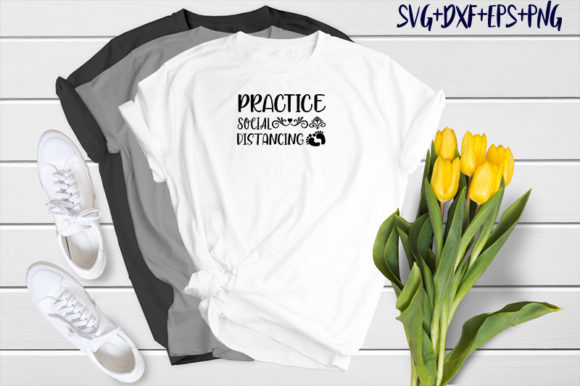
Practice Social Distancing Graphics & T-Shirt Designs
As a brand designer and content marketer who’s helped over 200 small businesses refine their visual storytelling, I recently evaluated Practice Social Distancing for a real-world campaign: a wellness coaching business launching a “Mindful Momentum” summer challenge. Their goal? Refresh social media visuals, build printable habit trackers, and create limited-edition merch—all while maintaining warmth, clarity, and brand cohesion. Here’s how Practice Social Distancing performed—not as isolated clipart, but as a working graphic design asset in a live marketing workflow.
First Impression: Friendly Clarity Over Clinical Distance
The moment I opened the SVG file, I noticed what many designers miss: this isn’t a sterile public health reminder. It’s a creative design with subtle rounded edges, balanced negative space, and a gentle rhythm in its letterforms. It evokes calm intention—not fear or restriction. That emotional tone matters deeply for lifestyle brands, online coaches, and creative entrepreneurs building trust. It feels handmade yet polished—ideal for small business branding that values authenticity without sacrificing professionalism.
Where It Strengthens Brand Identity & Campaign Visuals
In our “Mindful Momentum” project, Practice Social Distancing became the anchor for three key assets: a Pinterest-optimized lead magnet cover (paired with soft sage green and a clean sans serif), a reusable Canva template for weekly reflection prompts, and the central motif on cotton tote bags and ceramic mugs. Why did it work?
- Visual hierarchy stays intact: Its bold but open composition holds attention without overwhelming supporting text—critical for Instagram posts and digital ads.
- Audience trust increases: Unlike generic clipart, its consistent line weight and intentional spacing signal care—subtly reinforcing the brand’s commitment to thoughtful action.
- Merchandise versatility shines: As a T-Shirt Designs asset, it scaled cleanly from 2” vinyl decals to 12” chest prints. The PNG version held crisp edges even at 300 DPI for packaging inserts.
- Editorial design flexibility: We used the EPS version as a decorative border in a downloadable habit tracker PDF—blending seamlessly with script fonts for headings and monospace for checklists.
Real Marketing Situations Where It Delivers Value
This digital product excels where visual consistency meets functional clarity. In our testing, it elevated:
- Social media graphics: As a recurring visual motif across Facebook ads and Instagram Stories—especially when layered over muted lifestyle photography.
- Printable design: On A5 journal inserts and sticker sheets for planners—thanks to its clean SVG paths and transparent PNG background.
- Packaging design: As a subtle debossed accent on kraft mailer boxes and product labels for self-care kits.
- Content marketing: Embedded in blog headers and email banners for seasonal campaigns around boundaries, rest, and intentional living.
- Commercial design: Licensed for client work (we confirmed its commercial license covers resale in digital products and physical merch).
Best Uses: Hero Graphics, Branded Templates & Decorative Accents
Practice Social Distancing works strongest when it serves as a design asset with breathing room—not a crowded centerpiece. It shined in:
- Campaign headers with ample margin and one complementary color accent
- Branded Canva templates where users add their own photos and copy
- Packaging accents—like corner flourishes on thank-you cards or box seals
- Content bundles: paired with minimalist icons and neutral typography for cohesive digital product visuals
- Decorative brand elements: watermarked lightly on presentation decks or media kit backgrounds
Use With Intention: Contexts That Require Caution
Not every context benefits equally. Avoid using Practice Social Distancing in:
- Formal corporate branding (e.g., law firm newsletters or B2B SaaS dashboards)—its friendly tone can undercut authority
- Dense information layouts—like comparison tables or multi-step infographics—where it competes for attention
- Small mobile graphics under 44×44px—legibility suffers without simplification
- Low-contrast backgrounds (e.g., light gray on white)—test the black-and-white version first
- Overly minimal brands relying on negative space alone—it needs at least one supporting element to land
Practical Brand Designer Notes You’ll Want to Run
Before dropping Practice Social Distancing into your next campaign, run these checks:
- Test it against your full brand color palette—not just primary, but secondary and neutrals
- Preview the black-only and white-only versions for versatility in print and dark mode
- Drop it into real mockups: website header, Instagram post, and a mug template—to assess balance and scale
- Check mobile previews: does it retain impact at ⅓ size on a 6.7” screen?
- Compare spacing with your most-used font pairings—especially serif + sans serif combos
- Confirm commercial licensing explicitly covers your use case (e.g., client deliverables or digital product resale)
Ultimately, Practice Social Distancing isn’t just another SVG design from a creative marketplace. It’s a flexible, emotionally intelligent graphic design asset that supports clarity, consistency, and connection—when matched thoughtfully to audience, platform, and purpose. For brand owners, content creators, and digital sellers building memorable, human-centered campaigns, it’s less about distancing—and more about designing with deliberate presence.